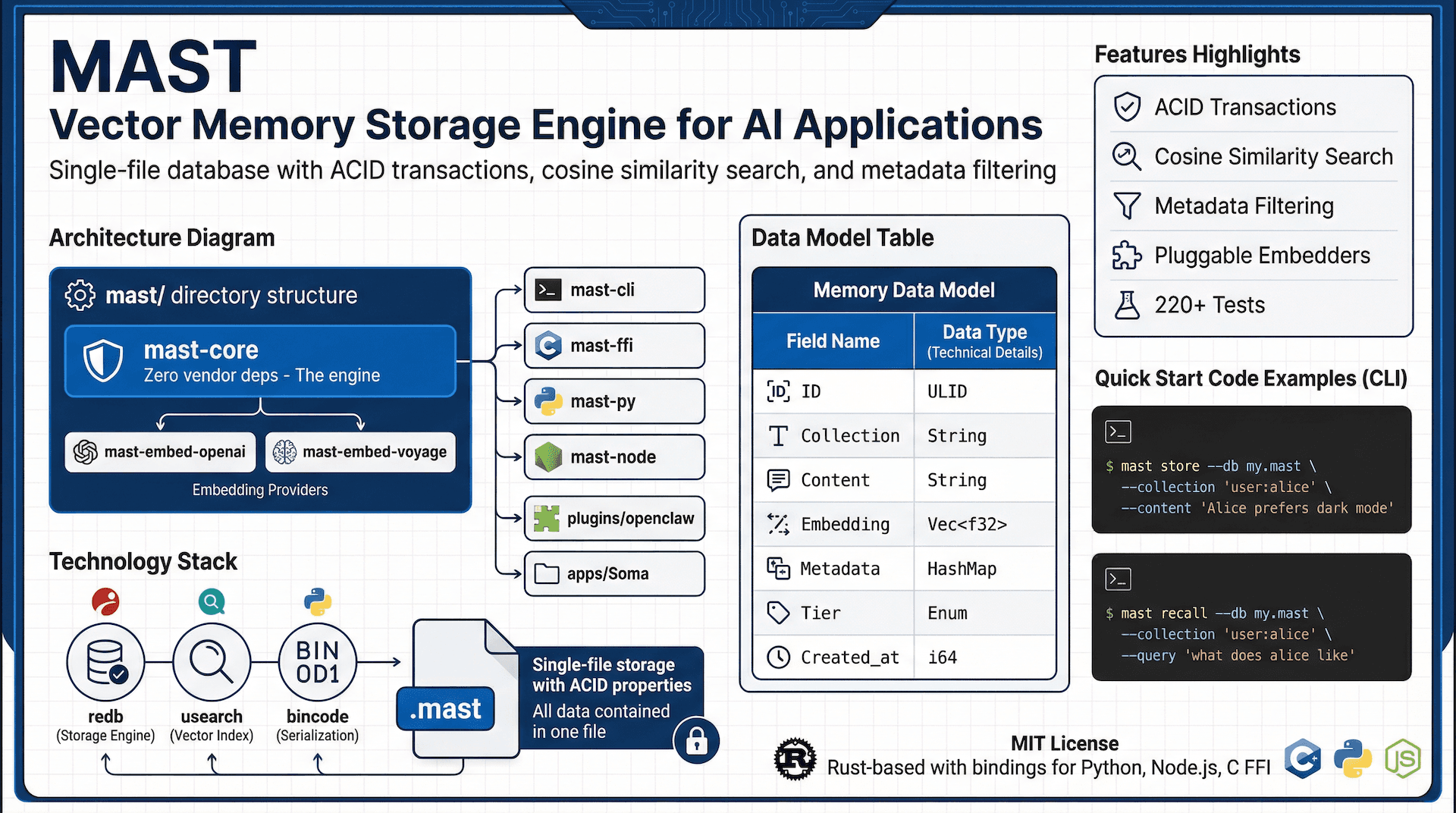
MAST
Single-file vector memory storage for AI applications. ACID transactions, cosine similarity search, and metadata filtering in a library that embeds directly into your agent runtime.
No daemon, no network hop, no separate service. Open a file path, store memories, query by vector similarity, and keep your model provider at the edge where it belongs.
Storage
Single file
one .mast database on disk
Recall
Cosine similarity
vector search + metadata filters
Bindings
Rust, Python, Node, C
plus CLI tooling
Core model
Embeddable
library, not a server
Why It Exists
Single-file memory store
MAST gives AI applications a local memory database that opens from a file path instead of requiring a separate service.
No daemon, no network hop
It opens like SQLite. Give it a file path, run queries in-process, and keep the latency and operational footprint low.
Vector search with metadata filters
The core engine focuses on storing memories, cosine-similarity recall, collection isolation, and metadata filtering during search.
Pluggable embedders
The storage layer stays vendor-neutral. Embedders are traits, so OpenAI, Voyage, mock embedders, or your own implementation can sit at the edge.
Core Operations
STORE
Write memory content, embeddings, metadata, tier, and timestamps in one ACID transaction.
RECALL
Run cosine-similarity search within a collection, optionally constrained by metadata filters.
GET
Fetch a memory directly by collection and ULID when you already know the identifier.
INFO
Inspect collection-level stats and database information from the same local engine.
Install
Native crate with optional embedders.
# Cargo.toml
[dependencies]
mast-core = { git = "https://github.com/ericc59/mast" }
mast-embed-openai = { git = "https://github.com/ericc59/mast" }  # optional
mast-embed-voyage = { git = "https://github.com/ericc59/mast" }  # optional
Usage
Full native flow: store, recall, get, and inspect.
use mast_core::{Mast, config::MastConfig, types::*, embed::MockEmbedder};
use std::collections::HashMap;

let config = MastConfig::default().with_db_path("my.mast");
let mut mast = Mast::open(config)?;
let embedder = MockEmbedder::new(4);

let memory = mast.store(StoreRequest {
    collection: "notes".into(),
    content: "The quick brown fox".into(),
    embedding: Some(vec![0.1, 0.9, 0.0, 0.0]),
    metadata: HashMap::from([("source".into(), "test".into())]),
    tier: Tier::Active,
}, &embedder).await?;

let results = mast.recall(RecallRequest {
    collection: "notes".into(),
    query: None,
    query_embedding: Some(vec![0.1, 0.9, 0.0, 0.0]),
    limit: 5,
    filter: Some(MetadataFilter::Eq("source".into(), "test".into())),
}, &embedder).await?;

let mem = mast.get("notes", &memory.id)?;
let info = mast.info()?;

mast.close()?;
Architecture
Storage
Single-file ACID storage via redb. Crash-safe copy-on-write B-trees. The file is the database.
Vector index
usearch HNSW indexes with cosine similarity. Per-collection indexes are serialized into redb.
Metadata + embedder boundary
Metadata filters are backed by an inverted index in redb, while embedders stay outside the core through a trait-based interface.
Why It Fits Agent Memory
Agent runtimes need durable local recall: user preferences, prior interactions, retrieved facts, and other memories that should be stored and queried without adding a separate vector database or network service.
Long-term recall
Store user facts, summaries, and prior interactions so agents can retrieve useful context across sessions.
Simple integration surface
Open a file, call store and recall, and keep the memory layer inside the application process.
Local-first operations
Everything lives in one file, which fits local agents that need portable state and low-latency recall.
Key Decisions
Single file, not client-server
You link it into the agent process and open a path. That cuts deployment complexity and keeps recall local.
Collection isolation
Recall in one collection never returns memories from another, so application namespaces stay clean by default.
Core stays vendor-neutral
No cloud SDKs or runtime services in the core engine. Model dependencies stay at the edge.
Stable core, optional integrations
The core engine stays focused. Bindings, CLI, and plugins like OpenClaw sit around it instead of being baked into storage internals.
Benchmarks
Criterion coverage across store, recall, filters, and interface boundaries. Run with cargo bench -p mast-core.